Central or State Government Jobs– Government jobs are one of the most popular career paths in India due to job consistency, respect from society, regular income and other long term employment. – Government jobs are one of the most popular career paths in India due to job consistency, respect from society, regular income and other long term employment. For many candidates, the question is whether to apply for Central Government (Indian Government jobs) or State Government jobs.
In India, government jobs are regarded as one of the best career opportunities available. Reason being, these jobs offer job safety and security, social status, steady pay and long term benefits (which are often many) to the individual working in them. Therefore, for many job seekers in India—especially for new graduates—securing a position in a government job is one of the most attractive goals they have. Amongst all of the available job opportunities within this sector, the largest decision faced by the majority of job applicants is which type of job to go after: Central Government jobs or State Government jobs?
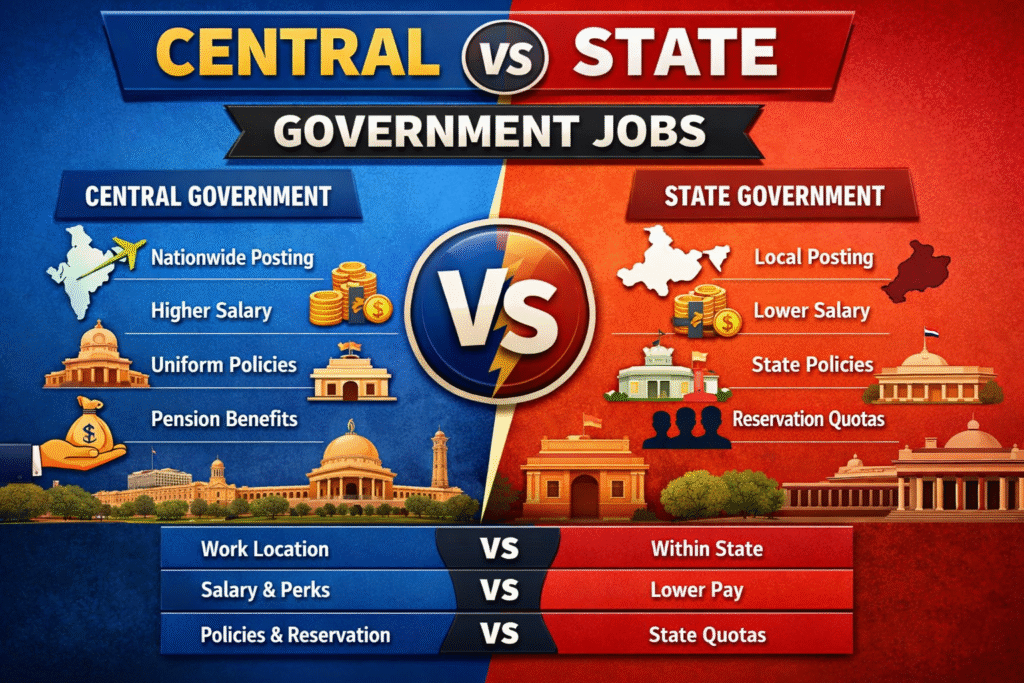
Table of Contents
Salary, transfers, promotions, and working environment are just a few of the many things that differ in these two job streams. This guide has been written to inform readers about these differences. Therefore, individuals, whether they have a computer science or technical background, or are simply graduates who want to explore their options regarding these two government sectors in 2025, will want to read this information to determine which job to pursue.
In addition, for individuals who may not fully understand what path to take, they may benefit from using Impacteers’ mentor program, which provides individuals with personalized guidance and support regarding their career paths and prepares them for the appropriate government job track. For government job aspirants, the biggest question individuals have is how to choose between Central Government Jobs vs. State Government Jobs. While both provide individuals with security and prestige, they differ in important areas including authority, salary structure, workforce location, promotion processes, and eligibility crite
Although both have similar advantages of being stable and prestigious, they differ in a number of important areas such as power, pay scales, work location, promotion processes and the qualifications required to apply. This guide will assist candidates in making an educated choice for their future career in Government Employment.
Meaning of Central and State Government Jobs
Central Government Jobs
The job on a national and state level has job creation by the Indian Central Government’s multiple governmental departments, ministries, and agencies working within India and by following the laws and policies established by the Government of India.
Examples of National Government Job Creation:
- UPSC (IAS, IPS, IFS)
- SSC (CGL, CHSL, MTS)
- Railways (RRB)
- Defence services
- Central PSU jobs (ONGC, BHEL, GAIL)
State Government Jobs
State government employment opportunities are provided by state departments and state agencies which operate under their respective state governments. The positions work on state administration together with state development tasks.
Examples:
- State PSC exams (PCS)
- State police services
- State teacher recruitment
- State secretariat jobs
- State PSU jobs
Governing Authority
The primary distinction between two entities exists in their respective controlling bodies. The President of India together with central ministries control all Central Government Jobs.-Central and State Government Jobs
The Governor together with state ministries control all State Government Jobs.
The difference between two systems affects job policies and transfer procedures and promotion processes and service regulations.
3. Job Location & Transfer Policy
Central Government Jobs
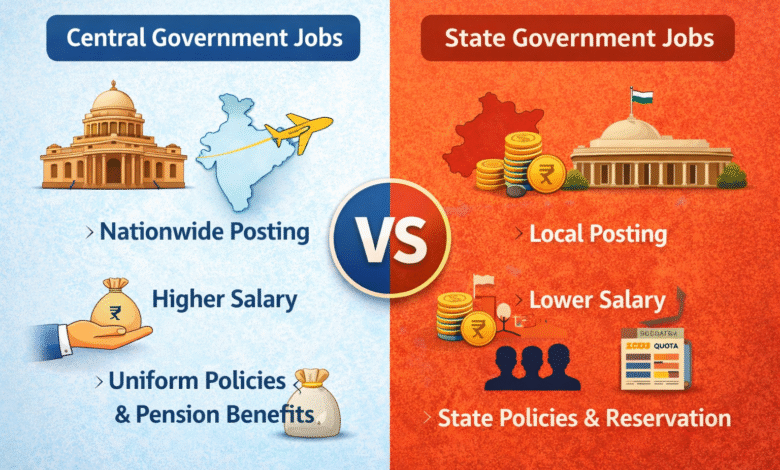
- Employees may be posted anywhere in India.
- Transferability is high, especially in services like Railways, Defence, Banking, and All India Services.
- Suitable for candidates open to relocation.
State Government Jobs
- Jobs are usually limited to one state.
- Transfers generally happen within the same state.
- Ideal for candidates who prefer working close to home.
4. Salary Structure & Pay Scale
Both Central and State Government jobs follow structured pay systems, but there are differences.
Central Government Salary
- Follows 7th Central Pay Commission (CPC).
- Generally higher basic pay and allowances.
- Uniform pay structure across India.
State Government Salary
- Follows State Pay Commission.
- Salary may vary from state to state.
- Allowances depend on state financial conditions.
👉 In most cases, Central Government jobs offer slightly higher salaries.
also read: Common Mistakes Students Make While Applying for Government Jobs (And How to Avoid Them)-2026
How to Maintain a Healthy Lifestyle During Exam Preparation
5. Allowances & Benefits
Central Government Jobs
- Dearness Allowance (DA)
- House Rent Allowance (HRA)
- Travel Allowance (TA)
- Medical benefits under CGHS
- Pension under NPS
State Government Jobs
- DA and HRA (state-specific rates)
- State medical schemes
- Pension benefits (varies by state)
Central jobs often provide better and more uniform benefits.
6. Recruitment Process
Central Government Recruitment
- Conducted by national bodies like UPSC, SSC, RRB, IBPS.
- Highly competitive at the national level.
- Candidates from all states can apply.
State Government Recruitment
- Conducted by State PSCs, State Staff Selection Commissions.
- Competition limited to state-level candidates.
- State domicile rules may apply.
7. Eligibility Criteria
Central Government Jobs
- Eligibility is uniform across India.
- Educational qualifications are standardized.
- No language restriction in most cases.
State Government Jobs
- May require state domicile.
- Knowledge of regional language is often mandatory.
- Reservation rules vary by state.
8. Promotion & Career Growth
Central Government Jobs
- Promotions are systematic and time-bound.
- Wider scope of career growth.
- Opportunity to work in national and international roles.
State Government Jobs
- Promotions depend on state policies.
- Career growth may be slower in some states.
- Limited exposure outside the state.
9. Work Pressure & Responsibility
- Central Government jobs often involve higher responsibility, policy-making, and nationwide impact.
- State Government jobs focus more on local administration and implementation.
Work pressure depends on department and post in both cases.
10. Job Stability & Security
Both types offer excellent job security, but:
- Central Government jobs are considered more stable due to stronger financial backing.
- State Government jobs depend on state finances but are still highly secure.
11. Social Status & Prestige
- Central Government officers, especially IAS, IPS, and central PSU officers, enjoy higher national recognition.
- State Government officers command strong respect at the local level.
Both provide significant social prestige.
12. Retirement Benefits
Central Government
- Pension under NPS
- Gratuity and retirement benefits are uniform
State Government
- Pension schemes vary by state
- Some states offer better old pension benefits
Central vs State Government Jobs: Quick Comparison
| Feature | Central Government | State Government |
|---|---|---|
| Governing Authority | Government of India | State Government |
| Work Location | Anywhere in India | Within the State |
| Salary | Higher (7th CPC) | State Pay Commission |
| Transfers | Nationwide | State-level |
| Language Requirement | Not mandatory | Often mandatory |
| Competition | National-level | State-level |
| Career Growth | Wider | Limited |
Which Is Better: Central or State Government Job?
There is no one-size-fits-all answer. The choice depends on your priorities:
Choose Central Government Jobs if: job link
- You want higher salary and national exposure
- You are open to transfers
- You aim for top administrative roles
Choose State Government Jobs if:
- You want to stay in your home state
- You prefer regional language work
- You want balanced work-life stability
Conclusion
Both Central and State Government jobs offer stability, respect, and long-term security. Understanding their differences helps aspirants align their career goals with the right path. Instead of focusing on which is better, focus on which is better for you.